
Back-to-School Mindfulness Tools for Families


Back-to-school season can bring excitement, new routines, and fresh beginnings.
It can also bring big feelings.
Children may feel nervous about new teachers, new classmates, harder schedules, earlier mornings, or being away from home. Parents and caregivers may feel the stress too as everyone adjusts to a new rhythm.
Mindfulness can help families slow down, connect, and create simple routines that support emotional wellness during the school-year transition.
These back-to-school mindfulness tools for families are simple, realistic, and easy to use at home.
Start With One Mindful Minute
You do not need a long practice to make a difference.
Start with one mindful minute each morning.
Before leaving for school, pause together and take three slow breaths.
You can say:
“Let’s take one minute to help our bodies feel ready for the day.”
Try this simple practice:
Put one hand on your heart.
Take a slow breath in.
Slowly breathe out.
Say one word for how you want to feel today.
Examples:
Calm
Brave
Kind
Focused
Ready
Peaceful
This helps children begin the day with intention instead of rushing straight into stress.
Create a Calm Morning Routine
Mornings can feel overwhelming when everyone is trying to get ready quickly.
A calm morning routine can help children know what to expect.
Try creating a simple visual checklist:
Get dressed
Eat breakfast
Brush teeth
Pack backpack
Put on shoes
Take three breaths
Leave for school
Keep the routine short and predictable.
Children often feel safer when they know what comes next.
Use an Emotion Check-In
Back-to-school feelings can change from day to day.
Some mornings children may feel excited.
Other mornings they may feel worried, tired, frustrated, or sad.
An emotion check-in helps children name what is happening inside.
You can ask:
“What color is your feeling today?”
“Are you feeling calm, nervous, excited, frustrated, or something else?”
Naming emotions helps children build emotional awareness. When children can name their feelings, they are more likely to learn how to manage them.
Pack a Small Reset Tool
A reset tool is something simple that helps a child feel grounded.
This could be:
A smooth stone
A small breathing card
A bracelet
A family note
A picture
A calming phrase
A soft keychain
A small heart drawn on paper
Before school starts, practice how to use it.
You might say:
“When you miss home or feel nervous, hold your reset tool and take one slow breath.”
This gives children a small reminder that they are supported, even when they are away from home.
Practice Breathing Tools Before Big Feelings Happen
Breathing tools work best when children practice them before they are upset.
Try practicing at bedtime, in the car, or during a quiet moment.
Balloon Breath
Pretend your belly is a balloon.
Breathe in and let the balloon fill.
Breathe out and let the balloon slowly shrink.
Hand Breathing
Trace up one finger as you breathe in.
Trace down the finger as you breathe out.
Repeat for all five fingers.
Smell the Flower, Blow the Candle
Pretend to smell a flower.
Then slowly blow out a candle.
This is simple, playful, and easy for younger children to remember.
Build an After-School Reset Routine
Children often hold it together all day at school.
Then they come home tired, hungry, overstimulated, or emotional.
Instead of jumping right into homework, questions, or chores, create a short after-school reset.
Try:
Snack
Water
Quiet time
Outside movement
Calm corner time
Drawing
Reading
Breathing practice
A few minutes of connection
You can say:
“You worked hard today. Let’s help your body reset.”
This gives children time to release the school day before moving into the evening routine.
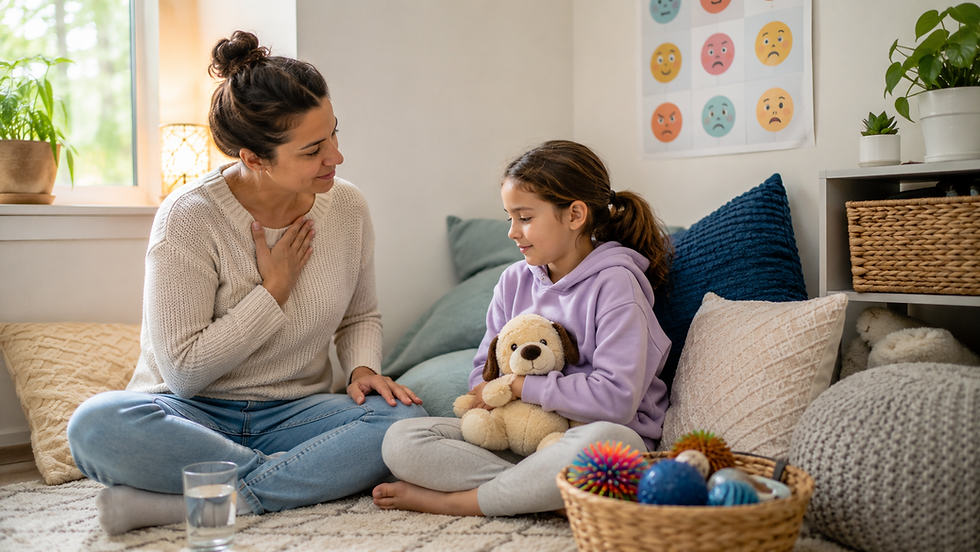
Create a Calm Corner at Home
A calm corner is a space where children can go to reset.
It does not need to be fancy.
It can be a small basket, a pillow, or a quiet spot in a room.
Helpful calm corner items may include:
Emotion chart
Breathing cards
Stuffed animal
Soft blanket
Books
Sensory bottle
Coloring pages
Calm-down checklist
Timer
Family photo
A calm corner should not be used as punishment.
It is a safe space for children to practice emotional regulation.
Use Connection Before Correction
Back-to-school stress can lead to more tears, frustration, pushback, or meltdowns.
When children are overwhelmed, they need connection before correction.
Try saying:
“I see this feels hard.”
“You are safe.”
“I am here to help.”
“Let’s take a breath first.”
“We can solve this together.”
After the child is calm, then you can talk about choices, expectations, or problem-solving.
Make Bedtime a Mindful Reset
Sleep is important during the school year, but bedtime can be hard when children are adjusting.
A mindful bedtime routine helps the body and brain slow down.
Try this simple bedtime practice:
Name one good thing from the day.
Name one hard thing from the day.
Take three slow breaths.
Say: “I am safe. I can rest. Tomorrow is a new day.”
This gives children a chance to process the day before sleep.
Keep It Simple
Mindfulness does not have to be perfect.
It does not have to be long.
It does not have to look a certain way.
For families, the best mindfulness tools are the ones that are simple enough to use on busy days.
Start with one tool.
Practice it often.
Let it become part of your family rhythm.
Final Thought
Back-to-school season is a transition for the whole family.
With small mindful moments, children can learn how to notice their feelings, calm their bodies, and feel supported through change.
A mindful school year does not mean every morning is peaceful or every emotion is easy.
It means children know they are not alone.
They have tools.
They have connection.
And they have adults helping them learn how to move through big feelings with support.
Want a simple way to support your child this school year? Download a Mindful Minutes resource to help your family practice calm, connection, and emotional awareness at home.


Comments