
Thoughts Aren’t Facts: A Simple Skill That Changes Everything for Kids
Updated: May 3

Most kids believe everything they think
A child says: "I feel like nobody likes me. “I’m bad at this. ”I can’t do it.”
To them, these don’t feel like thoughts. They feel like facts.
And when thoughts feel true, they shape:
Emotions
Behavior
Confidence
Relationships
This is why one of the most important skills we can teach children is:
Thoughts are not always facts.
Thoughts vs. Feelings (Why Kids Get Confused)
Children often say:
“I feel like nobody likes me”
But this isn’t a feeling—it’s a thought.
Here is a simple way to explain it:
Thoughts = what your brain says
Feelings = what your body feels
Example:
Thought: “Nobody likes me”
Feeling: Sad, lonely
Thoughts and feelings are connected, but they are not the same—and thoughts are not always true.

What Happens When Kids Believe Their Thoughts
When kids treat thoughts as facts, they may:
Shut down or withdraw
Become easily frustrated
Avoid trying new things
React with big emotions
Because their brain is telling them: "This is real. This is true.”
But when we teach: "This is just a thought”
Everything begins to shift.
A Simple Shift That Builds Emotional Strength
Instead of: "This is true”
Kids learn: "This is something my brain is telling me”
This creates space to:
Pause
Notice
Choose a response
This is where emotional regulation begins.

A Simple Shift That Builds Emotional Strength
Instead of: "This is true”
Kids learn: "This is something my brain is telling me”
This creates space to:
Pause
Notice
Choose a response
This is where emotional regulation begins.
How Mantras Help Kids Understand Their Thoughts
This is where mantras become powerful tools.
A mantra is a short, repeatable phrase that helps guide attention and calm the body.
For children, mantras help:
Interrupt negative thought patterns
Create separation from thoughts
Shift focus to something safe and helpful
Support emotional regulation
Why This Works
When a child repeats a mantra:
Their breathing slows
Their body begins to calm
Their brain shifts out of stress mode
They move from reacting to responding.
Mantras That Teach “Thoughts Aren’t Facts”
You can start with simple phrases like:
“This is just a thought”
“Thoughts are not always true”
“I can notice my thoughts and let them go”
“My brain is trying to help, but I am safe”
These phrases help children recognize that thoughts can be questioned rather than believed automatically.
Mantras for Emotional Regulation
Pair thought awareness with calming support:
“I am safe right now”
“I can take a breath and slowdown”
“Big feelings will pass”
“I can handle this moment”
This connects awareness of thoughts with calming the body.
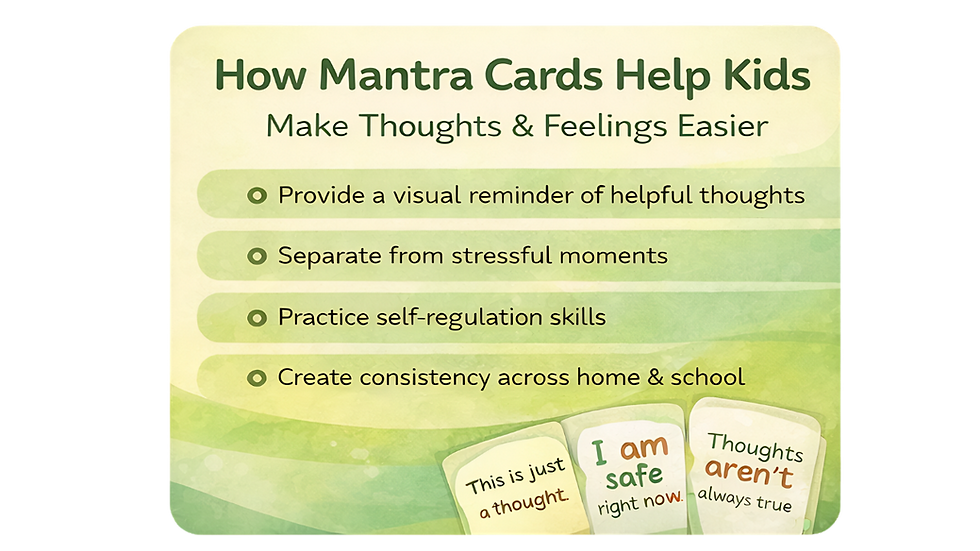
How Mantra Cards Make This Easier
Teaching this in the moment can be difficult, especially when emotions are high.
Mantra cards provide:
A visual reminder of helpful thoughts
A tool children can choose and hold
A way to practice when calm so it is accessible during stress
Why Mantra Cards Work
They simplify complex ideas
They make abstract concepts easier to understand
They encourage repetition, which builds new patterns
They create consistency across home and school
Instead of searching for the right words in a difficult moment, the support is already available.
How to Use Mantra Cards With Kids
Introduce them when the child is calm
Let children explore and choose a card they connect with
Practice together
Say the mantra slowly, paired with breathing or a calming action
Use during challenging moments
Gently guide:
“Let’s find a card to help your body feel safe”
Repeat consistently
Repetition builds emotional awareness and regulation skills
What Kids Learn Over Time
With practice, children begin to:
Notice their thoughts
Understand their feelings
Pause before reacting
Feel more in control
Build confidence and resilience
These are foundational skills for emotional intelligence and long-term mental wellness.
This Is Preventive Mental Health
We often wait until children are struggling to teach these skills.
But they can be taught early—before small thoughts turn into bigger challenges.
Helping children understand their thoughts gives them tools they can use throughout their lives.
Want to Try This at Home or in the Classroom?
We have created mantra cards and free tools to help children:
Understand their thoughts
Regulate their emotions
Build confidence and resilience
Be sure to like us on Facebook to stay up to date with our FREE DOWNLOADIBLE RESOURCES- Facebook page for Mindful Minutes. Free Resources Sponsored by Challenge to Change, Inc.
Final Thought
Just because a child thinks something does not mean it is true.
When children learn this, they begin to feel safer, more confident, and better able to navigate their emotions.



Comments